Within the industrial manufacturing clusters of Gujarat—spanning textile processing mills, chemical refineries, and power generation utilities—the steam boiler is the heart of production. Feeding water into these high-pressure boilers requires a specialized class of machinery: the Boiler Feed Pump (BFP).
A boiler feed pump must operate continuously, pushing high-temperature water into a vessel that is already under immense internal pressure. This requires a pump capable of generating exceptional head while handling thermal expansion without distorting.
When upgrading or designing a utility line, plant engineers are frequently faced with a choice: Should we install a heavy-duty Horizontal Multistage Centrifugal Pump or a compact Vertical Inline Multistage Pump?
While both configurations rely on multiple impellers stacked in series to build high pressure, their physical orientation heavily impacts their temperature handling, structural life, and ease of maintenance. Here is a technical breakdown to guide your specification.
1. Horizontal Multistage Pumps: Built for Thermal and Structural Extremes
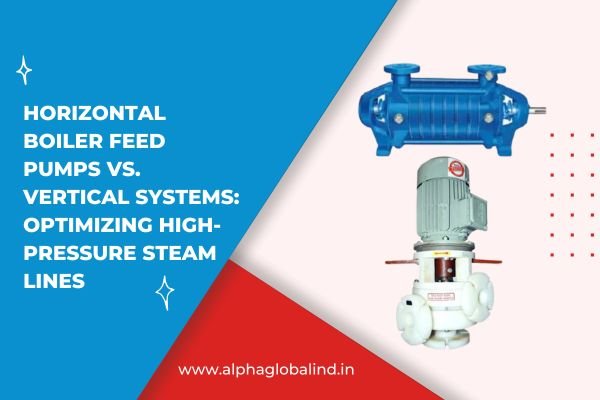
A Horizontal Multistage Centrifugal Pump features impellers arranged horizontally along a single shaft supported by bearings on both ends.
The Advantages:
- Superior Thermal Expansion Management: As boiler feed water temperatures rise (often exceeding 120°C to 150°C), the metal components expand. Horizontal designs handle this thermal stress exceptionally well because the pump casing can expand along its horizontal axis without causing shaft misalignment or binding.
- Heavy-Duty Bearing Support: Having bearings supporting the shaft at both the suction and discharge ends dramatically reduces vibration, enabling the pump to handle massive pressure spikes and continuous duty cycles for years.
- Lower NPSH Requirements: The horizontal arrangement naturally allows for optimized inlet geometries, which minimizes the risk of cavitation—a major issue when dealing with near-boiling feed water.
The Limitations:
- Large Footprint: These units require significant floor space, a dedicated concrete foundation, and precise laser alignment between the motor and the bare pump shaft during installation.
2. Vertical Multistage Pumps: The Compact Efficiency Experts
A Vertical Multistage Pump stacks its impellers vertically, utilizing an inline suction and discharge configuration that fits directly into a piping run.
The Advantages:
- Minimal Floor Space Required: Because the motor is mounted vertically on top of the pump housing, these units take up a fraction of the floor space compared to a horizontal skid.
- Simplified Installation: The inline design means the pump can often be installed directly into existing pipework like a valve, cutting down on initial piping layout costs.
- No Alignment Needed: The motor and pump shaft are rigidly coupled during manufacturing, completely eliminating the need for complex field alignment.
The Limitations:
- Strict Temperature Boundaries: High temperatures can cause the vertical shaft to expand upwards toward the motor, putting severe axial load on the motor bearings and increasing the risk of mechanical seal failure. They are generally limited to lower-pressure boilers or systems where feed water remains below 100°C–120°C.
- Overhung Shaft Load: Because the shaft is supported primarily from the top, extreme hydraulic pressures can cause minor shaft deflection over time, accelerating wear on internal wear rings and bushings.
3. Engineering Selection Matrix: Horizontal vs. Vertical
| Operating Parameter | Horizontal Multistage Pump | Vertical Multistage Pump |
| Typical Boiler Pressures | Medium to High (> 30 Bar) | Low to Medium (< 25 Bar) |
| Max Fluid Temperature | High (Up to 160°C or higher) | Moderate (Typically up to 120°C) |
| Physical Footprint | Large (Requires baseplate foundation) | Small (Compact vertical space)> |
| Shaft Support Design | Between-bearings (Dual-end support) | Overhung (Top-end heavy support) |
| Ideal Application | Co-generation plants, heavy chemical boilers | Small textile boilers, laundry plants, HVAC |
4. Avoiding the #1 Killer of Boiler Feed Pumps: Cavitation
Regardless of whether you choose a horizontal or vertical setup, the most common point of failure in steam utilities is feed water cavitation.
Because boiler feed water is stored at high temperatures in a deaerator tank, it is always close to its boiling point. If the pressure inside the pump inlet drops even slightly below the fluid’s vapor pressure, the water will flash into steam bubbles. When these bubbles move into the high-pressure zone of the impellers, they collapse violently, eroding the metal surfaces.
How to protect your pump:
- Ensure Adequate Net Positive Suction Head Available (NPSHA): Always mount your feed water tank or deaerator significantly higher than the pump inlet to provide a positive gravity head.
- Opt for a Horizontal Design if NPSH margins are tight: The horizontal casing allows for a wider eye on the first-stage impeller, which naturally lowers the pump’s internal suction velocity and reduces cavitation risk.
Conclusion: Matching Configuration to Boiler Duty
Forcing a compact vertical pump to handle a high-pressure, superheated steam loop will result in frequent mechanical seal burnouts. Conversely, specifying a massive horizontal multistage pump for a small laundry or process boiler is an unnecessary expenditure of capital and floor space.
As a reliable boiler feed pump manufacturer and exporter from Ahmedabad, Alpha Global customizes heavy-duty horizontal multistage centrifugal assemblies with specialized high-temperature mechanical seals and hardened metallurgies to match the exact pressure curves of your boiler system.