In chemical formulation plants, electroplating units, and industrial laboratories across Gujarat’s manufacturing hubs—including the active chemical clusters in Vatva and Ankleshwar—safely transferring hazardous fluids from standard 200L drums, carboys, or Intermediate Bulk Containers (IBCs) is a daily operational necessity.
Because fluids like concentrated sulfuric acid, nitric acid, flammable solvents, and sodium hydroxide are highly volatile or destructive, traditional manual pouring or tilting methods are completely unacceptable under modern environmental health and safety (EHS) guidelines.
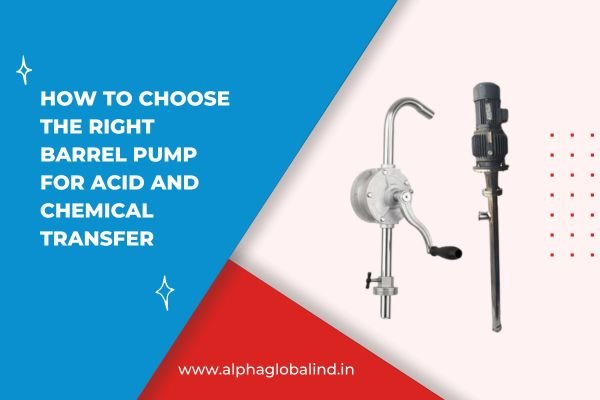
An industrial barrel pump (or drum pump) provides a safe, efficient, and highly controllable solution by using a vertical immersion tube designed to fit directly through the standard 2-inch bung opening of a container. However, because chemicals vary wildly in their reactivity, viscosity, and flammability, choosing the wrong barrel pump configuration can cause rapid equipment failure or dangerous on-site leaks.
Here is an engineering blueprint to help you specify the exact barrel pump components for your chemical transfer lines.
1. Immersion Tube Materials: Matching the Chemical Profile
The tube assembly that goes directly into the liquid must be entirely inert to the chemical being pumped. Selecting the wrong material can lead to rapid corrosion, fluid contamination, or catastrophic stress cracking.
| Immersion Tube Material | Recommended Chemical Media | Strategic Engineering Benefit |
| Polypropylene (PP) | Hydrochloric acid, diluted sulfuric acid, alkalis, plating chemicals | Excellent cost-to-performance ratio for general acids and bases at ambient temperatures. |
| PVDF (Kynar®) | Highly concentrated nitric acid, hydrofluoric acid, hot chemicals | Superior thermal and chemical stability; resists strong oxidizing agents that degrade PP. |
| Stainless Steel (SS-316) | Flammable solvents, alcohols, light oils, organic acids | High structural integrity; essential for flammable liquids because it can be safely grounded to prevent static arcs. |
2. Motor Selection: Pneumatic vs. Electric vs. Flameproof
The driving motor sits atop the immersion tube, entirely outside the drum. Your choice depends directly on the properties of the fluid and the surrounding plant environment:
High-Protection Flameproof Motors (ATEX / FLP)
If you are transferring volatile or flammable solvents like acetone, toluene, xylene, or ethanol, standard electric motors are a dangerous hazard. A tiny internal spark from the motor brushes could ignite ambient fumes. In these environments, you must specify a Flameproof (FLP) or explosion-proof electric motor certified for hazardous zones.
Air-Driven Pneumatic Motors
Pneumatic motors run entirely on compressed air, making them inherently spark-free and safe for hazardous chemical zones. They are lightweight, excel in high-humidity areas, and offer easy speed control via a simple air regulator valve. If your plant already has an active compressed air line near the decanting area, an air motor is often the safest and most reliable choice.
Standard Electric Motors
For non-flammable liquids, like agricultural acids or water treatment alkalis processed in safe zones, high-efficiency fractional horsepower electric motors provide simple plug-and-play operation with variable speed controls.
3. Structural Design: Seal-less vs. Mechanical Seal
Industrial barrel pumps generally utilize two distinct internal designs to guide the drive shaft through the immersion tube:
- The Seal-less Advantage: Modern chemical drum pumps often utilize a seal-less design. The fluid is allowed to rise slightly inside an inner tube jacket where it lubricates the shaft bushings before draining back into the container through bypass ports. Because there is no dynamic mechanical seal to wear out or run dry, seal-less barrel pumps require very little maintenance and are highly resilient against crystallizing fluids.
- Mechanical Seal Design: For applications involving highly aggressive chemicals that emit toxic or hazardous vapors that must be strictly contained, a mechanically sealed barrel pump is preferred. This ensures that no vapors escape the tube column during or after the transfer operation.
[Industrial Barrel Pump Configuration]

     [  Drive Motor  ]  <-- Electric / FLP / Pneumatic
            ||
     =======||=======   <-- Discharge Manifold
     |  Inner Shaft |
     |              |
     |  Immersion   |   <-- Material: PP / PVDF / SS-316
     |    Tube      |
     |              |
     ================
     [  Impeller  ]     <-- High-Velocity Axial Flow
4. Viscosity Constraints and Flow Dynamics
Standard barrel pumps are engineered for low-to-medium viscosity fluids. If you try to pump a thick polymer, paint, or heavy resin with a standard axial-flow impeller drum pump, the motor will quickly overload and trip out.
For thin liquids, a high-velocity axial impeller delivers fast, continuous transfer rates up to 80–100 liters per minute. However, if your chemical’s viscosity exceeds 200 to 500 centipoise, you must switch to a progressive cavity or positive displacement barrel pump design that uses a heavy-duty motor gear reduction unit to handle the fluid’s resistance.
Conclusion: Securing Your Decanting Stations
Specifying a barrel pump requires balancing chemical compatibility with strict plant safety codes. By correctly pairing a PP, PVDF, or SS-316 immersion tube with an inherently safe pneumatic or flameproof motor, you can eliminate dangerous manual handling, protect your staff, and stop chemical waste across your facility.
If your production team requires customized immersion tube lengths (such as extended lengths for deep IBC tanks), automated batch dosing attachments, or an expert chemical compatibility review, Alpha Global’s technical engineering team in Ahmedabad is ready to construct a system tailored to your process.