For industrial plant engineers, managing fluid viscosity is one of the most demanding transport challenges. As a fluid’s resistance to flow increases, standard kinetic pumping systems (like centrifugal designs) experience a massive drop-off in efficiency. The pump ends up wasting energy shearing and churning the fluid inside the volute casing rather than displacing it down the line.
For high-viscosity, non-Newtonian fluids—such as thick chemical polymers, dewatered wastewater sludges, molasses, and filled resins—positive displacement is non-negotiable.
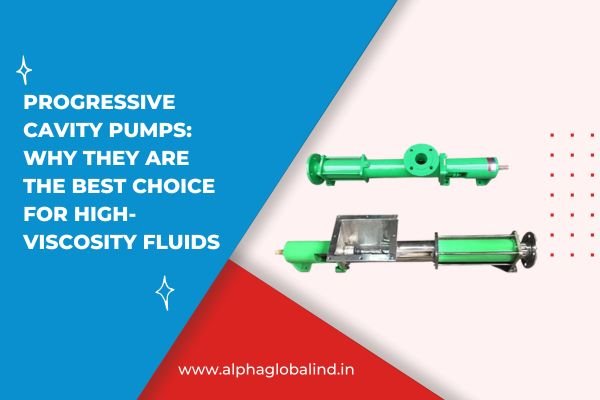
Among these systems, the progressive cavity pump (also widely known as a single screw or eccentric screw pump) stands out as the ultimate engineering solution. Its specific geometric design allows it to move heavy, solid-laden, or sticky substances with minimal friction and maximum volumetric efficiency.
The Geometry of Progressing Cavities: How It Works
As the rotor turns, the trapped fluid pocket inside the hose is forced smoothly toward the discharge port. When the shoe or roller releases the compression, the natural restitution (rebound) of the hose creates a strong vacuum that draws the next volume of fluid into the pump.
Because the fluid is completely contained within the hose, there is zero internal slippage. The displacement is perfectly proportional to the rotational speed, providing a linear, repeatable accuracy that can easily achieve variance limits below ±1%.
[Progressive Cavity Pump Internal Fluid Travel]

Suction End                                 Discharge End
=============================================================
Fluid In ->  [Cavity A] -> [Cavity B] -> [Cavity C] -> Out
=============(  Rotor  )===(  Rotor  )===(  Rotor  )======
             (  Stator )   (  Stator )   (  Stator )
=============================================================
   Fixed Volumetric Pockets Moving Progressively Forward
When the rotor turns within the stator, a series of identical, sealed, chain-like cavities are formed. As the rotor moves eccentrically, these cavities progress forward from the suction side to the discharge side.
Because the volumetric profile of each cavity is completely fixed, the pump acts as a true positive displacement system. The fluid isn’t squeezed or compressed between the rotor and stator; it is simply trapped in a pocket and carried smoothly to the exit.
Key Engineering Advantages for Viscous Applications
Process plants throughout Gujarat’s manufacturing hubs—such as the heavy industrial zones in Vatva, Odhav, and Sanand—rely on progressive cavity systems over other positive displacement types for three primary reasons:
1. Viscosity-Independent Volumetric Flow
In a centrifugal pump, a surge in fluid viscosity causes the flow rate to plunge. In a progressive cavity pump, the flow rate is directly proportional to the rotational speed (RPM) and remains virtually independent of the fluid’s thickness or system back-pressure. In fact, higher viscosities often reduce internal “slip” (the minute amount of fluid that escapes backward past the sealing lines), actually improving the pump’s volumetric efficiency.
2. Extremely Low Shear Fluid Handling
Many viscous chemical formulations are highly shear-sensitive; if subjected to high-velocity impact or violent churning, their molecular structure breaks down, altering their properties. Because the moving cavities inside a progressive cavity pump transport the medium gently without any rapid pressure changes or turbulence, the fluid experiences almost zero shear stress. This preserves the exact texture and integrity of the product.
3. True Pulsation-Free Discharge
Unlike reciprocating diaphragm or piston pumps that move fluid in distinct pulses, progressive cavity pumps deliver a continuous, steady stream. This smooth, laminar flow is critical when feeding downstream processing equipment, automated filling lines, or sophisticated industrial spray nozzles that require uniform material distribution.
Rotor and Stator Metallurgy: Optimizing for Wear
| Component | Common Material Grades | Strategic Application |
| Rotor | AISI 304 / 316 Stainless Steel, Tool Steel (Hard Chrome Plated) | Plating reduces friction coefficients and resists scratching from abrasive quartz or chemical crystalline scale. |
| Stator | Nitrile Rubber (NBR), EPDM, Viton (FKM), Hypalon | Elastomer flexibility allows the stator to deform around passing solid particles and rebound without scoring. |
Crucial Operation Tips to Prevent Stator Failure
While incredibly resilient, progressive cavity pumps have one core vulnerability: they cannot run dry. Because the sealing line between the metal rotor and rubber stator relies on the process fluid itself for lubrication, dry running creates rapid friction heat. Within minutes, this thermal buildup can scorch or melt the elastomer stator, destroying the internal vacuum.
To protect your system, always integrate a dry-running protection sensor (such as a temperature probe in the stator wall) and ensure the suction line is flooded before startup.
Conclusion: Mastering the Heavy Flows
When your process involves materials that refuse to flow easily, the progressive cavity pump offers the reliable, positive displacement and gentle handling required to keep your production lines moving efficiently. By eliminating pulsation, handling high solids, and overcoming extreme viscosity barriers, it remains an indispensable asset for modern industrial engineering.
If your plant requires customized hopper-feed pumps, high-pressure multi-stage screw pumps, or an optimization audit for your existing viscid fluid lines, Alpha Global’s engineering specialists in Ahmedabad are ready to design and deliver a system built for your exact parameters.