Across India’s expanding highway networks and infrastructure projects—supported by hot-mix asphalt plants, bitumen emulsion terminals, and roofing material manufacturing units throughout Gujarat—handling bulk bitumen and tar is a crucial daily operation.
Bitumen presents a unique fluid transport challenge because its viscosity varies dramatically with temperature:
- At Ambient Temperatures (25°C to 30°C): Bitumen is virtually a solid or semi-solid resin with a viscosity exceeding 1,000,000 cPs.
- At Elevated Operating Temperatures (140°C to 180°C): Bitumen thins down into a pumpable fluid with a viscosity dropping to between 100 cPs and 500 cPs.
If the temperature inside the pump drops even slightly during transfer, the fluid instantly hardens into a dense mass. Attempting to start a pump containing solidified bitumen will instantly shear drive shafts, strip gear teeth, or burn out driving motors.
Here is an engineering blueprint on best practices for selecting and operating high-temperature jacketed pumps for bitumen and tar.
The Core Solution: Steam or Thermal Oil Jacketed Casing
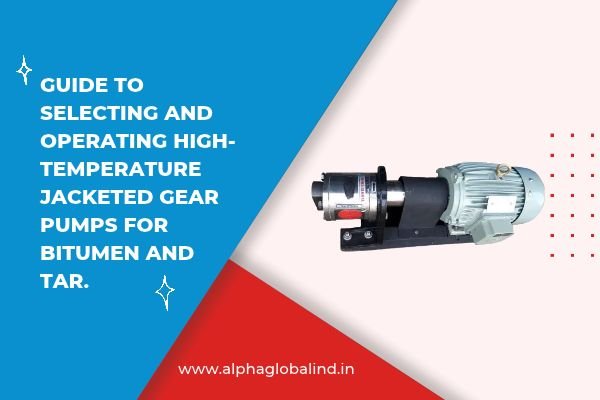
To prevent bitumen from cooling and seizing inside the pump chamber, standard non-jacketed pumps cannot be used. Instead, you must specify a jacketed rotary gear pump or jacketed progressive cavity pump.
A jacketed pump features a double-walled chamber built around the pump casing, front cover, and stuffing box area.
               [Thermal Jacketed Gear Pump Cross-Section]

         ======================================================
         |  Hot Thermal Oil / Steam Circulation Jacket        |
         |  ------------------------------------------------  |
         |  |   Bitumen / Hot Tar Fluid Pumping Chamber    |  |
         |  |                                              |  |
         |  |  [ Drive Gear ]     [ Driven Gear ]          |  |
         |  |                                              |  |
         |  ------------------------------------------------  |
         |  Hot Thermal Oil / Steam Circulation Jacket        |
         ======================================================
Before the pump motor is switched on, hot steam or thermal heating oil (thermic fluid) is continuously circulated through the outer jacket chamber. This indirect heating raises the internal temperature of the metal pump body above the melting point of bitumen (typically preheated to 130°C–150°C), melting any residual binder trapped inside the gear meshes and allowing the pump to rotate freely.
Key Fluid Mechanics: Managing Viscosity and Shaft Speeds
Absorbed Power ∝ Viscosity × Speed²
Engineering Best Practices for Speed and Sizing:
- Reduce Shaft Speeds (RPM): Always run bitumen pumps at lower operational speeds—typically between 100 RPM and 400 RPM—using a heavy-duty helical gear reducer unit.
- Increase Internal Clearance: Specify enlarged internal clearances between the gear teeth and the pump casing wall to allow hot bitumen to pass through without generating excessive mechanical shear.
- Keep Pipe Lines Heated: Ensure all suction and discharge piping manifolds are fully heat-traced (using electric heating tape or steam tracing lines) and heavily insulated. Cold piping will cause the leading edge of the bitumen stream to solidify, creating massive line blockages.
Sealing Systems for High-Temperature Bitumen
Option A: High-Temperature Graphite Packing Glands
Option B: Heavy-Duty Mechanical Seals with Quench Flush
Bitumen & Tar Pumping Parameter Matrix
| Operating Parameter | Standard Industrial Standard | High-Temperature Bitumen Standard |
| Operating Temperature | Ambient (20°C to 40°C) | 140°C to 200°C+ continuous service |
| Casing Construction | Standard Cast Iron / Ductile Iron | Steam/Hot Oil Jacketed Ductile Iron / Cast Steel |
| Shaft RPM Range | 960 RPM to 1440 RPM | 100 RPM to 350 RPM (via Gearbox) |
| Drive System | Direct Flexible Coupling | Heavy Reduction Gearbox / V-Belt Drive |
Conclusion: Thermal Control Guarantees Flow
Successfully pumping bitumen, asphalt binders, and coal tar relies on precise thermal control. By integrating fully jacketed gear pumps, reducing shaft speeds with heavy-duty gearboxes, and maintaining heated pipeline networks, you can eliminate cold-start damage and keep asphalt production running smoothly.
If your hot-mix road construction plant, emulsion refinery, or roofing manufacturing facility requires heavy-duty jacketed gear pumps, high-temperature bitumen decanting skids, or specialized thermal oil heating advice, Alpha Global’s technical engineering team in Ahmedabad is ready to build a reliable system for your site.