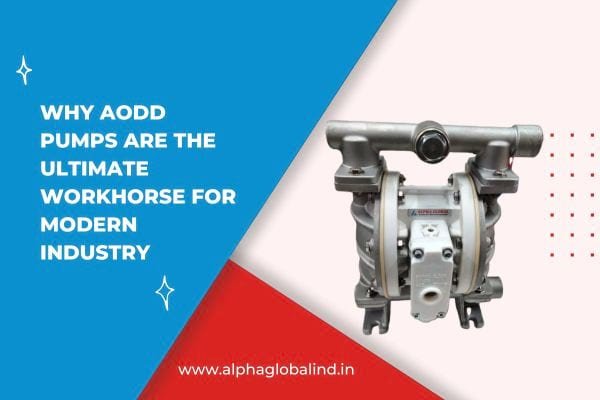
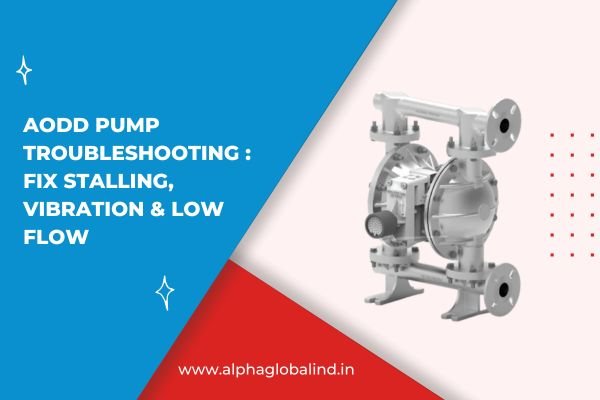
Across the industrial clusters of Ahmedabad—from the chemical reactors in Vatva to the wastewater treatment plants (ETPs) servicing textile mills in Odhav—the Air Operated Double Diaphragm (AODD) pump is celebrated as a rugged, self-priming workhorse. Its ability to run dry without damage and handle high-solids slurries makes it indispensable.
However, because these pumps are entirely pneumatic, their performance is intimately tied to the dynamics of your compressed air supply and piping configuration. When an AODD pump underperforms, it is rarely a mechanical defect within the pump itself; more often, it is a symptom of a system-wide imbalance.
If your production line is facing erratic pumping cycles, here is an engineering-focused troubleshooting blueprint to diagnose and fix the five most common AODD pump issues.
1. The Pump Stalls, Freezes, or Won’t Cycle
You open the air main, but the pump remains completely stagnant, or it strokes a few times and locks up mid-cycle.
- The Diagnostic Cause: Assuming your air line pressure is adequate (typically above 1.5 to 2 bar for initial stroke), the primary culprit is pneumatic icing or a fouled main air valve. When compressed air expands rapidly inside the pump’s air distribution system, its temperature drops sharply. If there is ambient moisture or water vapor suspended in your compressed air line, it freezes instantly, forming ice crystals that choke the pilot valve or main spool.
- The Engineering Fix: Inspect your air preparation setup. Every AODD pump should be preceded by a dedicated Filter-Regulator-Lubricator (FRL) unit. If icing is a chronic issue due to Ahmedabad’s monsoon humidity, install an upstream air dryer or a point-of-use water separator. Alternatively, reducing the inlet air pressure slightly or scaling up the exhaust muffler size can minimize rapid pressure drops and prevent thermal freezing.
2. Excessive Harmonic Vibration and Piping Noise
The pump is moving fluid, but the entire piping manifold is shaking violently, generating heavy water hammer and stressing mechanical joints.
- The Diagnostic Cause: Extreme vibration points directly to hydraulic cavitation or structural fluid starvation. If the pump is cycling faster than the fluid can physically fill the outer diaphragm chambers, the diaphragms flex against a partial vacuum, causing vapor bubbles to collapse violently. This happens when pumping highly viscous polymers or oils through a suction line that is too narrow.
- The Engineering Fix: Never throttle or restrict the intake/suction plumbing line. Ensure your suction hose or pipe diameter matches or exceeds the pump’s inlet port size. If you are handling viscous fluids, reduce the air pressure to slow down the stroke rate, allowing the heavy fluid sufficient time to completely fill the fluid chamber on each stroke. To eliminate lingering pulse waves on the discharge side, integrate a charging pulsation dampener directly ahead of your rigid piping.
3. The Pump Cycles Rapidly but Fails to Prime or Move Fluid
The pump is “thumping” at a high rate of speed, but nothing is emerging from the discharge pipe.
- The Diagnostic Cause: This indicates a complete loss of internal vacuum on the suction side. The internal diaphragm mechanism is moving air instead of pulling liquid. The root cause is either a microscopic air leak in the suction plumbing or check valves that are failing to seat properly.
- The Engineering Fix: Check every flange gasket, threaded joint, and camlock coupling on the suction line. Even a pinhole leak that doesn’t leak liquid outward can draw enough air inward to prevent the pump from pulling a priming lift. Next, inspect the internal check valve balls and seats. If debris, rags, or scale are wedged under the ball valves, they cannot form the tight hydraulic seal required to force fluid upward into the discharge manifold.
4. Significant Drop in Volumetric Flow Rate
The pump functions correctly but its output has steadily declined—for instance, dropping from its rated performance down to a fraction of its baseline capacity.
- The Diagnostic Cause: Internal mechanical wear or high back-pressure. Over months of handling abrasive materials or corrosive chemical acids, the check balls can become oblong, eroded, or “egg-shaped,” allowing fluid to slip backward during the discharge stroke. Alternatively, a partially blinded or clogged suction strainer could be starving the system.
- The Engineering Fix: Strip down the fluid manifolds to inspect the ball valves, seats, and O-rings. If you are handling severe abrasives, upgrade from standard rubber components to high-density PTFE, Viton, or polyurethane spares. Additionally, double-check your downstream line: if a filter press or discharge valve has become obstructed, the increased system back-pressure will naturally slow down an AODD pump’s cycling rate.
5. Liquid Discharging from the Air Exhaust Muffler
Liquid is visibly spraying or leaking out of the pneumatic muffler located on the air valve assembly.
- The Diagnostic Cause: This is a critical indicator of a ruptured diaphragm. Once a primary diaphragm splits or tears due to chemical degradation or flex fatigue, the process fluid bypasses the liquid chamber, enters the internal air distribution mechanism, and blows out through the exhaust.
- The Engineering Fix: Shut off the air supply immediately to protect your air valve from chemical corrosion. Disassemble the fluid covers, flush the air motor thoroughly, and install a fresh diaphragm pair. To prevent premature failures, cross-reference your fluid’s chemical composition and temperature profile with your material selection. Upgrading from standard Neoprene or Buna-N to Santoprene or specialized PTFE back-and-face diaphragms can drastically extend runtime.
Technical Maintenance Checklist for Plant Operators
| Maintenance Target | Operational Parameter | Corrective Action |
| Air Supply Quality | Check FRL water traps | Drain collected moisture; replace air filter elements |
| Fastener Torque | Inspect manifold & outer chamber bolts | Re-torque to factory specifications to stop fluid/air weeping |
| Muffler Cleanliness | Check exhaust port for oil or particulate buildup | Clean or replace muffled elements to prevent air back-pressure |
Conclusion: Balancing Your Pneumatic System
Optimizing an AODD pump relies on supplying it with clean, dry compressed air and ensuring its suction lines are completely airtight. By systematically identifying whether your issue stems from pneumatic freezing, fluid starvation, or check-valve bypass, you can solve nearly all performance dips right on the plant floor.
If your system requires specialized engineering consultation, customized elastomer kits, or high-performance, bolted-design process pumps built to withstand harsh manufacturing environments, Alpha Global’s technical team is ready to evaluate your configuration.