In food and dairy manufacturing plants across India —from our large-scale milk processing dairies to confectionery and sauce production units—maintaining product consistency is everything. Consumers expect the exact same texture, taste, and mouthfeel every time they open a package.
However, many food processing engineers face an unexpected enemy in their production line: the wrong transfer pump.
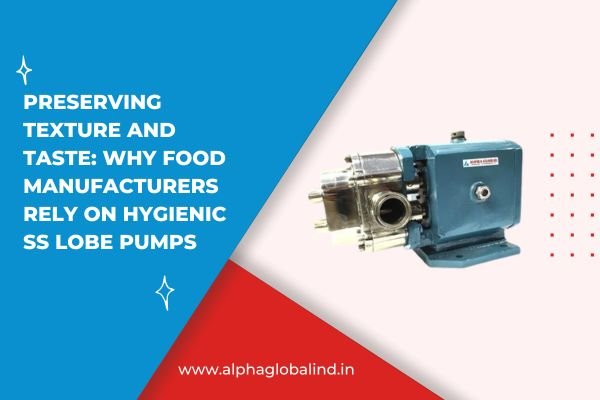
Food products are highly complex fluids. They are often thick, full of delicate solids, or structurally sensitive to friction. If you attempt to pump a delicate food item using a standard water pump or a high-speed centrifugal system, you risk ruining the entire batch. Here is an engineering breakdown of why Hygienic Stainless Steel Rotary Lobe Pumps are the preferred choice for the modern food industry.
1. Preventing the Danger of "Shear Thinning" and Separation
Many food items are shear-sensitive. This means that when they are subjected to high-velocity mechanical forces, their molecular structure breaks down, permanently changing their viscosity and texture.
- The Problem with Standard Pumps: A centrifugal pump spinning at 1440 or 2880 RPM slaps the fluid with an impeller. This intense friction can cause cream to churn into butter, cause mayonnaise or salad dressings to separate into oil and water, and break down the smooth starch bonds in ketchup, leaving it watery.
- The Rotary Lobe Solution: Lobe pumps are positive displacement machines that operate at very low rotational speeds (typically 100 to 400 RPM). The two lobes mesh smoothly without touching, gently pulling the food fluid into large internal pockets and moving it forward. This low-shear action ensures that emulsions, dairy fats, and complex syrups maintain their exact structural properties.
2. Moving Whole Fruits and Solids Without Crushing
From fruit-topped yogurts and jams to salsa with vegetable chunks, many modern foods contain soft solids that must remain intact for visual appeal and bite texture.
A standard pump treats these solids like a blender, cutting and crushing them into a smooth puree. Because a rotary lobe pump features large, open cavities between the lobe wings and the casing walls, it can pass whole fruit pieces, seeds, nuts, and curds effortlessly without crushing them. The product exits the pipe looking exactly like it did when it entered the hopper.
3. Handling Extreme Food Viscosities
Food processing involves moving liquids that are thousands of times thicker than water. Consider chocolate, peanut butter, honey, or molten cheese.
As viscosity increases, a centrifugal pump loses almost all its flow capacity and begins to overheat due to internal fluid friction. Rotary lobe pumps, however, thrive on high viscosities. In fact, because thicker fluids create a better internal seal inside the pump clearances, a lobe pump often becomes more efficient as the food product gets thicker.
4. Uncompromising Food Safety and Sanitation (CIP/SIP Compliance)
In food manufacturing, a pump must be completely cleanable to eliminate any risk of bacterial growth, mold, or batch cross-contamination. Alpha Global’s food-grade lobe pumps are engineered specifically for sanitary environments:
- SS-316L Stainless Steel: All wetted parts are cast from premium, low-carbon Stainless Steel, which resists the corrosive organic acids found in tomatoes, citrus fruits, and brines.
- Mirror-Polished Internals: The interior surfaces are electropolished to an ultra-smooth finish (Ra < 0.8 μm). This prevents organic matter from sticking to the walls.
- Clean-In-Place (CIP) Ready: The pump’s internal geometry contains zero “dead zones” or stagnant pockets. During a CIP cycle, sanitizing fluids can freely flush through the entire pump head without requiring maintenance teams to dismantle the machine.
5. Food Application Matrix: Matching the Lobe to the Product
To achieve the best results, the internal lobe geometry can be customized based on your specific food recipe:
| Food Category | Examples | Key Challenge | Recommended Lobe Style |
|---|---|---|---|
| Dairy Processing | Cream, Yogurt, Cheese Curd | Fat separation, shear sensitivity | Tri-Lobe (Low pulsation) |
| Confectionery | Molten Chocolate, Caramel, Honey | Extreme viscosity, sticky sugars | Bi-Wing / Twin-Lobe (High torque) |
| Fruit & Bakery | Jams, Fruit Fillings, Batter | Delicate solids, large particle sizes | Single / Twin-Lobe (Max particle clearance) |
| Sauces & Dressings | Mayonnaise, Ketchup, Mustard | Emulsion stability, acid corrosion | Tri-Lobe (Smooth, uniform flow) |
Conclusion: Investing in Brand Consistency
In food manufacturing, your pump is an extension of your recipe. Choosing a system that respects the delicate nature of food science ensures high throughput, total hygienic compliance, and a flawless final product that satisfies your customers.
As a premier hygienic food pump manufacturer and exporter from Ahmedabad, Alpha Global customizes sanitary SS-316L rotary lobe assemblies with food-grade elastomers (FDA approved) and specialized mechanical seals to keep your processing facility running at peak performance.