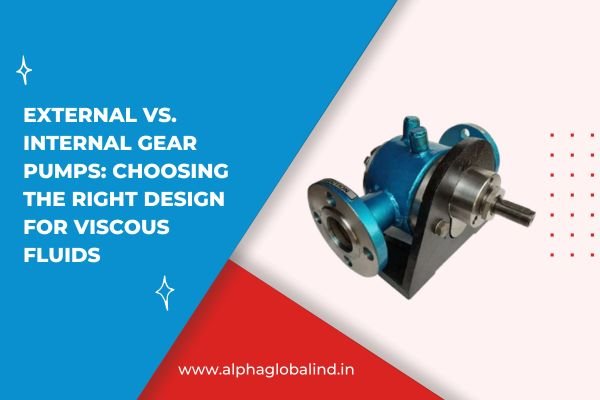
In the manufacturing plants and packaging units across India, transferring viscous fluids like lubricating oils, fuel oils, resins, and polymers is a daily requirement. For these applications, rotary gear pumps are the preferred choice due to their positive displacement design, which delivers a constant, pulsation-free flow regardless of pressure changes.
However, many engineers and procurement officers don’t realize that “gear pump” is a broad category. The two primary types—External Gear Pumps and Internal Gear Pumps—rely on different mechanical configurations and excel in completely different operational environments.
Selecting the wrong design can lead to rapid mechanical wear, internal slippage, or an inability to handle your fluid’s specific viscosity. Here is an engineering breakdown of how these two technologies compare.
1. External Gear Pumps: High Pressure and Precision
An External Gear Pump utilizes two identical, interlocking gears mounted side-by-side on separate shafts. One gear is driven by the motor (the drive gear), which in turn drives the second gear (the idler gear). As the teeth unmesh at the inlet side, they create a vacuum that draws fluid into the pump. The fluid is then carried around the outside of the gears within the casing pockets and forced out through the discharge side as the teeth mesh again.
The Advantages:
- High Pressure Capabilities: Because the shafts are supported by bearings on both sides of the gears, external gear pumps can handle high-pressure discharges (often up to 20-30 bar or more) without shaft deflection.
- Excellent Speed Control: They run at higher speeds than internal gear pumps, making them highly effective for precise metering and dosing applications of clean oils.
- Cost-Effective Maintenance: The design is structurally simpler, making it easier to assemble, troubleshoot, and source replacement parts for.
The Limitations:
- Viscosity Restrictions: While they handle moderate viscosities well, extremely thick fluids can struggle to fill the small gear pockets at high RPMs, leading to starvation and cavitation.
- Zero Tolerance for Solids: The clearances between the gear teeth and the pump housing are microscopic. Even tiny abrasive particles will lock up or score the pump internals.
2. Internal Gear Pumps: The High-Viscosity Masters
An Internal Gear Pump operates using an asymmetric, gear-within-a-gear design. It features an outer rotor gear with internally facing teeth, and a smaller internal idler gear with externally facing teeth. A crescent-shaped spacer, built into the pump head, sits between the two gears to seal the fluid pockets as they unmesh and mesh.
The Advantages:
- Superior High-Viscosity Handling: The large, open cavities between the gear teeth allow it to effortlessly draw in and move incredibly thick materials like asphalt, bitumen, molasses, resins, and heavy polymers.
- Low Shear Fluid Movement: Because they operate at much lower rotational speeds (RPM) than external gear pumps, they provide a very gentle, low-shear pumping action. This makes them ideal for fluids that degrade under high friction.
- Bi-Directional Operation: Most internal gear configurations can operate in reverse, allowing you to strip or empty discharge lines after a transfer cycle is complete.
The Limitations:
- Pressure Limitations: Because the idler gear is mounted on a single overhung pin rather than supported by bearings on both sides, they are generally limited to low-to-medium pressure applications.
- Higher Complexity: The presence of the crescent seal and the internal bushing makes the design more complex to manufacture and repair.
3. The Comparison Matrix: External vs. Internal
| Technical Feature | External Gear Pump | Internal Gear Pump |
| Gear Layout | Side-by-side (Two identical gears) | Gear-within-a-gear (Rotor and Idler) |
| Typical Viscosity Range | Low to Moderate (Up to 10,000 cSt) | Moderate to Extremely High (Up to 1,000,000 cSt) |
| Operating RPM | High (Typically 720 to 1440 RPM) | Low (Typically 100 to 400 RPM) |
| Pressure Rating | High | Low to Medium |
| Ideal Fluids | Hydraulic oils, diesel, light lube oils | Resins, bitumen, molasses, heavy polymers |
4. Application Mapping for Industrial Buyers
When finalizing your procurement plan with your gear pump supplier in Ahmedabad, use the following rule of thumb:
- Specify an External Gear Pump if: You are building a hydraulic power pack, transferring clean diesel or light lube oils, or require a high-pressure, steady fluid delivery system where space is tight and the fluid is clean.
- Specify an Internal Gear Pump if: You are working in a chemical or processing facility moving heavy, viscous materials that are prone to hardening or require low-shear handling to protect the fluid’s structural integrity.
Conclusion: Engineering Your Flow Profile
Forcing an external gear pump to move heavy resin will cause the motor to trip due to over-torque, while using a large internal gear pump for low-viscosity diesel transfer is an expensive over-specification. Matching the internal geometry of the gears to your fluid’s absolute viscosity is the key to achieving system longevity.
As an established rotary gear pump manufacturer and exporter from Ahmedabad, Alpha Global customizes both internal and external gear profiles with optimized metallurgies (including Cast Iron, Cast Steel, and Stainless Steel) to fit your precise process requirements.