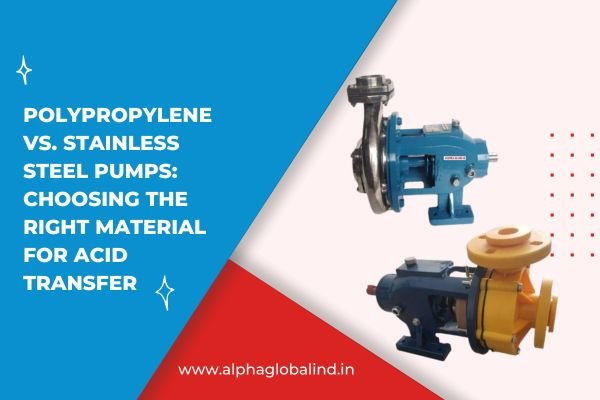
In Ahmedabad’s booming chemical manufacturing, electroplating, and pharmaceutical industries, safely moving aggressive acids is one of the most critical daily operations. The choice of pump metallurgy or material construction isn’t just about efficiency; it’s about plant safety and preventing catastrophic leaks.
A common misconception among procurement teams is that Stainless Steel (SS-304 or SS-316) is the ultimate solution for every heavy-duty industrial application. While Stainless Steel is incredibly strong and handles high temperatures exceptionally well, it has a major vulnerability: chemical corrosion.
For many aggressive acids, an engineered thermoplastic like Polypropylene (PP) is not only a fraction of the cost of high-grade alloys, but it is also completely immune to the chemical attacks that destroy metals. Here is an engineering guide to comparing PP and SS for chemical process pumping.
1. Polypropylene (PP) Pumps: Complete Chemical Inertness
Polypropylene is a high-density, lightweight thermoplastic engineered specifically to withstand aggressive environments. In a PP Centrifugal Pump, all wetted parts—including the casing, impeller, and backplate—are molded from solid polypropylene.
The Advantages:
- Zero Corrosion from Aggressive Acids: PP is completely inert to highly corrosive acids like Hydrochloric Acid (HCl), diluted Sulfuric Acid (H2SO4), Phosphoric Acid, and various plating chemicals that cause rapid pitting and stress-corrosion cracking in metals.
- Cost-Effective Engineering: Compared to exotic alloys like Hastelloy, Titanium, or even high-grade Stainless Steel, PP pumps offer a significantly lower capital investment.
- No Metallic Contamination: Because the pump is non-metallic, there is zero risk of metal ions leaching into the fluid. This is vital for ultra-pure chemical processing and electronics manufacturing.
The Limitations:
- Temperature Constraints: PP pumps are generally limited to a maximum operating temperature of around 60°C to 70°C. Beyond this, the plastic can soften and lose structural integrity.
- Pressure and Impact Limits: As a thermoplastic, PP cannot handle the extreme high-pressure surges or severe external mechanical impacts that a metal pump housing can withstand.
2. Stainless Steel (SS) Pumps: Mechanical Strength & Thermal Resilience
Stainless Steel pumps rely on a chromium oxide surface layer to resist corrosion. They are the standard workhorses for clean liquids, high temperatures, and high-pressure duties.
The Advantages:
- High Temperature Limits: SS pumps can effortlessly handle fluids blistering at temperatures well over 100°C up to 250°C.
- Structural Ruggedness: They withstand high system pressures, water hammer, and rough industrial environments without cracking or deforming.
- Excellent for Solvents: SS has superb resistance to organic solvents, hydrocarbons, and alcohols, which can sometimes cause certain plastics to swell or degrade.
The Limitations:
- The “Acid Vulnerability”: Acids containing chlorides (like Hydrochloric Acid) rapidly strip away the protective chromium layer of Stainless Steel. Once this layer is compromised, the acid eats through the metal casing with alarming speed.
- High Initial and Maintenance Cost: High-grade SS configurations represent a significant upfront financial asset and require specialized welding if structural repairs are ever needed.
3. Chemical Compatibility Checklist
Before finalizing your order with a chemical pump manufacturer, cross-reference your fluid profile against this material boundary index:
| Chemical / Fluid Media | Concentration | Polypropylene (PP) | Stainless Steel (SS-316) |
| Any % | Excellent (Recommended) | Highly Vulnerable (Do Not Use) | |
| Sulfuric Acid (H2SO4) | Up to 60% | Excellent | Moderate (Risk of Corrosion) |
| Nitric Acid (HNO3) | Diluted | Good | Excellent |
| Sodium Hydroxide (Caustic) | Any % | Excellent | Good (Up to certain temps) |
| Organic Solvents (Acetone/Toluene) | 100% | Poor (Risk of Swelling) | Excellent (Recommended) |
4. Operational Summary: Making the Right Specification
- Choose a Polypropylene (PP) Pump if: You are transferring ambient-temperature, highly corrosive industrial mineral acids, pickling liquors, or electroplating chemicals where metal corrosion is a constant threat and you want an affordable, long-lasting solution.
- Choose a Stainless Steel (SS) Pump if: Your process fluid is a solvent, operates at high pressures, or exceeds 75°C, requiring structural metallic strength over plastic chemical resistance.
Conclusion: Material Selection Dictates Pump Lifespan
Using a Stainless Steel pump to transfer hydrochloric acid is an expensive mistake that guarantees mechanical failure, while forcing a standard PP pump to handle hot solvents will warp the impeller. Analyzing both the temperature profile and chemical composition of your fluid is the only way to safeguard your process line.
As a leading PP chemical pump manufacturer and exporter in Ahmedabad, Alpha Global engineers robust, injection-molded polypropylene centrifugal systems equipped with specialized Teflon/Ceramic mechanical seals to ensure completely leak-free chemical management.