In the processing industries of India — ranging from chemical distillation and pharmaceutical manufacturing to textile drying—maintaining a reliable vacuum is essential. However, when it comes to selecting an industrial vacuum system, many engineering teams face a common dilemma: Should we install an Oil-Sealed vacuum pump or a Water Ring (Liquid Ring) vacuum pump?
Both technologies are excellent, but they operate on fundamentally different principles and are designed for entirely distinct operating environments. Selecting the wrong one can result in constant oil contamination, frequent lock-ups, or excessive utility bills.
Below, we break down the engineering differences to help you specify the right system for your application.
1. Water Ring Vacuum Pumps: The Rugged Workhorse
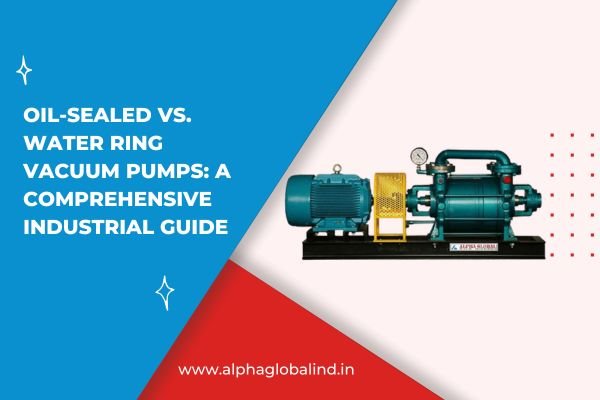
A Water Ring (or Liquid Ring) vacuum pump utilizes a liquid—typically water—to create a seal. An eccentrically mounted rotor spins inside the pump casing, flinging the water outward by centrifugal force to form a moving ring of liquid. This liquid ring seals the spaces between the rotor blades, creating compression chambers.
The Advantages:
- Isothermal Compression: As gas is compressed, the heat generated is immediately absorbed by the sealing water. This makes it incredibly safe for handling explosive, volatile, or temperature-sensitive vapors.
- Extreme Liquid and Solid Tolerance: If your process carries over slugs of liquid, condensable vapors, or minor particulate matter from a process line, a water ring pump handles it easily. The liquid simply merges with the sealing water.
- Low Mechanical Wear: There is no metal-to-metal contact between the rotating blades and the stationary housing, resulting in exceptionally long intervals between mechanical overhauls.
The Pitfalls:
- Lower Ultimate Vacuum: Because the ultimate vacuum is limited by the vapor pressure of the sealing water, these pumps typically cannot achieve the ultra-deep vacuum levels required by certain high-tech chemical processes.
- Water Consumption: They require a continuous supply of sealant liquid, necessitating either a constant water feed or an auxiliary closed-loop recovery system.
2. Oil-Sealed Vacuum Pumps: The Precision Performer
Oil-Sealed rotary vane or piston vacuum pumps use specialized industrial oil to lubricate moving parts, seal internal tolerances, and dissipate heat.
The Advantages:
- Deep Ultimate Vacuum: Oil has a significantly lower vapor pressure than water. This allows oil-sealed systems to achieve a much deeper, more precise vacuum level, making them mandatory for applications like vacuum distillation, freeze-drying, and laboratory environments.
- High Volumetric Efficiency: The tight internal clearances maintained by the oil film allow the pump to pull down volume rapidly and efficiently.
- Compact, Self-Contained Design: These units do not require external water piping networks or cooling towers to maintain their primary seal.
The Pitfalls:
- Vapor Sensitivity: If your industrial process exhausts moisture, solvent vapors, or acids, these contaminants will condense inside the pump and mix with the oil. This dilutes the oil, destroys its lubricating properties, and leads to rapid internal corrosion and mechanical failure.
- High Maintenance Requirements: The oil must be monitored, filtered, and changed regularly to maintain performance.
3. Technology Comparison Matrix
| Operational Metric | Water Ring Vacuum Pump | Oil-Sealed Vacuum Pump |
| Ultimate Vacuum Level | Moderate (Up to ~30 mbar) | High (Up to 10 -3 mbar or deeper) |
| Vapor/Moisture Tolerance | Excellent (Condenses & flushes out) | Poor (Contaminates the oil) |
| Explosive Gas Handling | Safe (Cool internal operation) | Risk of ignition if not ATEX rated |
| Primary Consumable | Water / Process compatible liquid | Industrial Vacuum Oil |
| Maintenance Profile | Low (Minimal moving parts wear) | High (Frequent oil and filter changes) |
4. Application Mapping: Which One Fits Your Industry?
To avoid operational headaches, map your process parameters directly to the pump style:
Choose a Water Ring System if:
- Your process involves solvents, condensable gases, or high moisture carryover (e.g., vacuum filtration, sterilization, evaporation plants, or solvent recovery systems in Ahmedabad’s chemical zones).
- You want a low-maintenance machine that can handle rough, continuous plant abuse.
Choose an Oil-Sealed System if:
- Your process is completely clean and dry, free of corrosive gases or moisture.
- Your application demands a deep, precise vacuum profile that water-based systems cannot physically achieve (e.g., transformer oil purification, vacuum packaging, or metallurgy).
Conclusion: Engineering the Correct System
There is no universal “best” pump; there is only the right pump for your specific industrial envelope. Protecting an oil pump from vapors requires complex filtration systems, while achieving a deep vacuum with a water ring pump requires multi-stage ejectors. Selecting the correct base technology from day one prevents thousands of rupees in unnecessary operational corrections.
As an established industrial vacuum pump manufacturer and exporter from Ahmedabad, Alpha Global custom-builds both liquid ring and rotary vacuum configurations tailored to your specific process targets.